We, the @o1_exchange team:
1. Act with integrity.
2. Make money.
3. Have fun.
In that order.
Supremacy isn't a claim about anyone else. It's the standard we hold ourselves to.
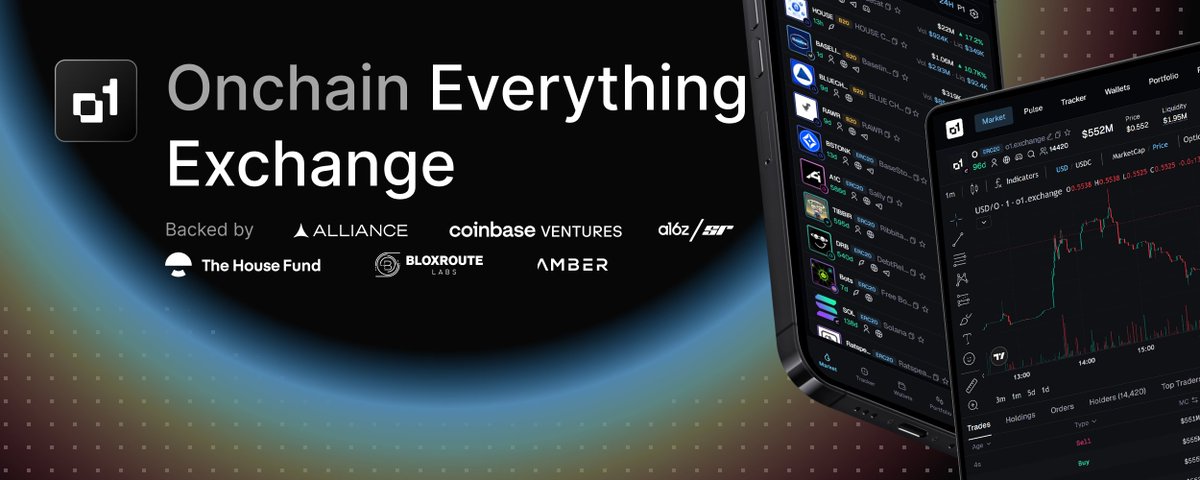
o1.exchange is the Onchain Everything Exchange. Some call us the onchain Coinbase. We're 15 people on three continents with 7 live product lines. We're profitable, running at $30M+ in annualized revenue, and our launchpad has cleared $1.2B+ in lifetime volume. We're backed by Coinbase Ventures, a16z, AllianceDAO, and 60+ angels and institutional investors.
Next, we scale into a global team serving billions in monthly volume and millions of onchain addresses. This doc is the operating system we use to get there: how we measure, hire, own, communicate, and partner.
We wrote it for ourselves. We're publishing it because the fastest way to find the right teammates and partners is to show exactly how we work. If this reads like common sense, we should talk. The world is big. The circle is small.
1. Revenue >>> Cost
Every action, hire, partner, and deal at o1 gets judged against one inequality: does it create far more value than it costs? Not ≥. >>>.
That's the axiom. Everything else in this doc is derived from it. We expand aggressively into anything that satisfies it, and we cut anything that doesn't: process, product, spend, commitments.
Metrics
- Revenue is the only metric that ultimately matters. Every other metric we track measures something upstream or downstream of it.
- Good metrics are the north star for incentives, alignment, prioritization, and resource allocation. If we can't measure it, we can't reward it.
- Every metric has a counter-metric. Volume is checked by retention. Growth is checked by trust. A great hire or a great deal moves the core number without breaking its counter.
- The hard line: we never trade trust, product experience, or user retention for short-term revenue. That isn't margin. It's a loan against the future at a terrible rate.
BD runs on two ledgers
We run BD on two CRMs: supply (token teams, projects, chains, liquidity) and demand (traders, communities, distribution partners). Every BD action maps to a dollar value we can weigh against its cost.
We hold ourselves to the same math. Our BD/ambassador comp pool is a fixed share of launchpad revenue, and every launch is tagged with the BD who sourced it. Comp follows attribution, not vibes.
"Winning together" is not a plan
When people say "let's win together," usually nothing happens next except cheering. We'd rather define it: one DRI on each side, a deliverable with a ship date, and a number both sides agree to measure.
That's how we run partnerships. As a distributed team, it's also how we run ourselves.
2. Hardcore
o1 is a hardcore team. To us that means high talent density, full ownership, high standards, and actually enjoying hard problems.
We look for clear signals of exceptional ability:
- IMO / IOI / ICPC / IPhO medalists
- High Codeforces ratings
- Titled chess players
- National and Olympic-level athletes
- Founders and operators who built something real from zero
- Traders with standout onchain PnL
Why these signals? They're hard to fake, they compound over years, and they show that someone can train alone and perform under pressure.
Signals, not gates. No medal but a track record that says the same thing (a protocol you shipped, a community you grew, a hard problem you cracked)? Show us.
We hold ourselves to the bar we hire for. I'm an ICPC winner and a chess International Master. And we're AI-native: everyone ships with agents in the loop, because a 15-person team should operate with the leverage of 150.
3. DRI
Every metric has exactly one Directly Responsible Individual, accountable for its ultimate success.
- End-to-end ownership. Pull in whatever people and resources you need. No excuses, no "not my team."
- Move fast through ambiguity. Don't wait for clarity. Bring it, and act without needing guidance.
- Push, don't pull. Over-communicate. Share progress and flag blockers before anyone asks. If people have to chase a DRI for a status update, the DRI is already behind.
4. Minimum unit of communication: P/PS
Never bring a Problem without a Proposed Solution.
Your solution can be wrong. That's what discussion is for. But arriving with one forces you to think first, and it turns every thread into a decision instead of a dumping ground.
5. Efficient meetings
- Async by default. A meeting needs a decision to make; status updates go in writing.
- Pre-read, then meet. The agenda and context go out beforehand. Come having read them.
- Smallest group that can decide. Everyone else gets the notes.
- End with owners and dates. No owner, no action item.
Work with us
If you read this and nodded along, we want to hear from you. This is our career page: https://o1.exchange/careers.
- Builders: we're hiring AI-native product engineers (smart contracts/DeFi + backend/frontend + product sense) and hardcore engineers. Open roles: https://app.notion.com/p/o1-exchange-Hiring-JDs-387d90ea373780a6be29d50a6890456f
- BD & growth: operators who think in pipelines and dollars, not impressions. Open roles: https://x.com/stambouli_o1/status/2105889908871279028
- Partners: token teams, chains, liquidity providers, and distribution partners who want to grow on Base and beyond. DM @stambouli_o1 on X, or get a warm intro through the @o1_exchange team.
Sky is the limit.