
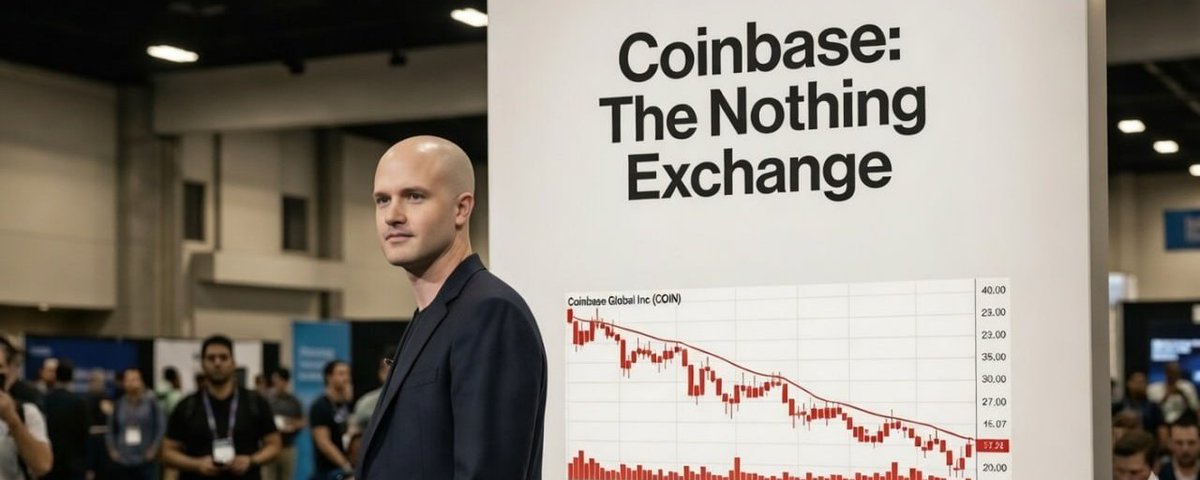
This is the current sentiment after the earnings report yesterday. Here’s my thesis as to why this is overblown and why I think $COIN is currently undervalued.
Below is my teardown in 3 parts: (1) what actually happened in 2025, (2) what the market is paying for COIN vs HOOD + fintech, (3) the Base strategy that’s quietly becoming @coinbase's strongest moat.
1) High-level overview of Coinbase 2025 earnings call
Full-year 2025
- Total revenue: $7.181B (Coinbase calls out +9% YoY)
- Net income (GAAP): $1.260B
- Adjusted EBITDA: $2.808B (≈ 39% Adj. EBITDA margin on total revenue)
- Subscription & services revenue: $2.828B (a real cycle-resistant pillar now)
Q4 2025
- Total revenue: $1.781B (down ~22% YoY per multiple outlets)
- Transaction revenue: $983M
- Subscription & services: $727M (stablecoin revenue was a major driver)
- Net loss (GAAP): $667M / -$2.49 EPS
- Adjusted net income: $178M (Adj EPS $0.66)
- Adjusted EBITDA: $566M
Why GAAP looked awful: Coinbase explicitly attributes the Q4 GAAP loss largely to unrealized investment losses (crypto investment portfolio + strategic investments), not core ops.
The “boring but important” signals we should care about
- Balance sheet / dry powder: $11.3B cash & cash equivalents at end of 2025.
- Aggressive capital return: repurchased $1.7B of stock in Q4 and through Feb 10, 2026, with additional authorization mentioned.
- Mix shift: subscription + services is now large enough to cushion trading volatility—and stablecoin revenue is increasingly the “rate-sensitive” engine inside that bucket.
Jerry’s takeaway: Coinbase is trying to be valued less like “a crypto broker” and more like a multi-product financial platform with embedded infra revenues.
2) Valuation comparison: Coinbase vs Robinhood + top fintech
Coinbase's market cap hovers around $38 billion in early 2026, with a trailing P/E of about 12, remarkably compressed for a growth stock in fintech. This reflects the earnings miss but also undervalues its ecosystem moat. Let's stack it against Robinhood and other heavyweights using core metrics like market cap, P/E, revenue growth, and EV/EBITDA. Data is as of mid-February 2026.
Company Market Cap ($B) Trailing P/E FY 2025 Revenue ($B) Revenue Growth (YoY) EV/EBITDA Coinbase (COIN) 38 12 7.2 +9% ~10x (est. based on $2.3B EBITDA) Robinhood (HOOD) 64 35 4.5 +52% ~25x (est. based on $2.5B EBITDA) PayPal (PYPL) 36 15 33.2 +4% ~8x Block (SQ) 33 20 ~24 (est. annualized) +10% (Q3 est.) ~15x SoFi (SOFI) 24 44 3.6 +35% ~20x
Key Insights from the Comparison:
- Vs. Robinhood: HOOD's explosive 52% revenue growth and record $2.05 EPS for 2025 justify its premium P/E of 35. They added 1 million Gold subscribers and saw net deposits hit $68 billion, fueled by options and equities trading. Coinbase, with slower growth, trades at a discount—its P/E is one-third of Robinhood's, despite similar Q4 EPS ($0.66). But Coinbase's $7.2B revenue dwarfs HOOD's $4.5B, and its cash hoard ($11B) enables aggressive buybacks vs. Robinhood's focus on deposits. Robinhood wins on retail trading momentum, but Coinbase's crypto exposure could outperform in a bull run.
- Vs. PayPal: PYPL's mature scale ($33B revenue) comes with anemic 4% growth and a Q4 miss ($8.68B vs. $8.8B expected). Its P/E of 15 edges out Coinbase, but with CEO turnover and competition from Apple/Google Pay eroding branded checkout, PayPal feels like yesterday's fintech. Coinbase's diversification into Base and stablecoins mirrors PayPal's early playbook but with blockchain edge.
- Vs. Block and SoFi: Block's crypto bets (via Cash App) align with Coinbase, but its Q3 2025 EPS beat ($0.54) hasn't translated to valuation pop. P/E is around 20 amid AWS outages hitting its infrastructure. SoFi's 40% Q4 revenue jump to $1B and 1 million member adds scream hypergrowth, but its 44x P/E reflects this as a premium. Coinbase sits in the value sweet spot: undervalued relative to SoFi's consumer fintech focus, yet more diversified than Block's Bitcoin focus.
Interpretation: the market is pricing Robinhood like a high-duration consumer fintech compounding machine, and pricing Coinbase like a cyclical business that investors still don’t fully trust to stay “boring” across cycles.
- Jerry’s insight: if you believe Coinbase as a high-duration consumer fintech machine like $HOOD too over time, then this seems as an undervalued opportunity. Overall, Coinbase's valuation screams "buy the dip" for long-term believers. At 12x P/E, it's trading like a legacy bank despite 23% subscription growth, being cheaper than the fintech sector average of ~20x. If crypto rebounds and Base scales, this could look like a steal.
3) Base strategy: Coinbase’s most under-appreciated compounding engine
Coinbase is effectively building a 3-layer stack:
- Layer A: “Everything Exchange”
Management is explicit: trade crypto, derivatives, equities, prediction markets, etc. in one trusted venue.
This is a distribution strategy: keep assets on platform, widen product per user, reduce churn.
- Layer B: USDC + payments = the cycle-resistant revenue machine
In Q4, stablecoin revenue was a meaningful portion of subscription & services (and grew vs prior periods), and Coinbase emphasizes deepening USDC’s role as collateral + settlement + “onchain money.”
My take: Coinbase’s best business is quietly becoming “regulated access to dollars onchain.”
If you believe stablecoins will keep expanding globally, Coinbase’s “payments & rails” narrative becomes a fintech narrative.
- Layer C: Base as the onchain operating system
The shareholder letter makes Base’s intent unusually clear:
- Base is positioned as “the app platform” with faster rails and better consumer UX, citing upgrades like ~200ms block times and “very low median fees.”
- Coinbase claims Base reached Stage 1 decentralization (permissionless fault proofs + security council).
- They’re bundling Base into a consumer surface (“Base App”) that combines wallet + trading + payments + social + messaging + mini apps + identity (“Base Account”) + Base Pay.
The interesting insight (the “why this matters”)
Most exchanges monetize when users trade. Coinbase is trying to monetize when the world transacts, even when users aren’t speculating.
If Base becomes the default onchain rail for:
- payments (USDC checkout, payouts, B2B treasury),
- embedded wallets,
- consumer apps that do micro-transactions,
…then Coinbase earns in more places than just spread/fees. It becomes closer to:
- Visa rails + App Store distribution + AWS primitives, all wrapped in a regulated brand.
That’s the real “cycle-resistant” bet.
The risk to watch (and it’s very relevant to me)
Coinbase has to thread a needle:
- Base must stay credibly open (otherwise builders don’t trust it long-term), while Coinbase still wants enough control to ship a coherent consumer product (Base App) and capture value.
That delicate balance, open network vs integrated super-app, is where the next 12–24 months of execution will be crucial.
Coinbase’s “Everything Exchange” vision in 2026 is to turn Coinbase from a primarily crypto spot broker into one trusted venue where users can trade multiple asset classes and instruments, and also things like derivatives and other “tradable” products.
As someone who's gone through Coinbase's rigorous vetting process for founders (one of the few companies whose round is led by Coinbase Ventures in the past 3 years), I've always viewed Coinbase as a foundational builder with long term views in this fast paced industry.
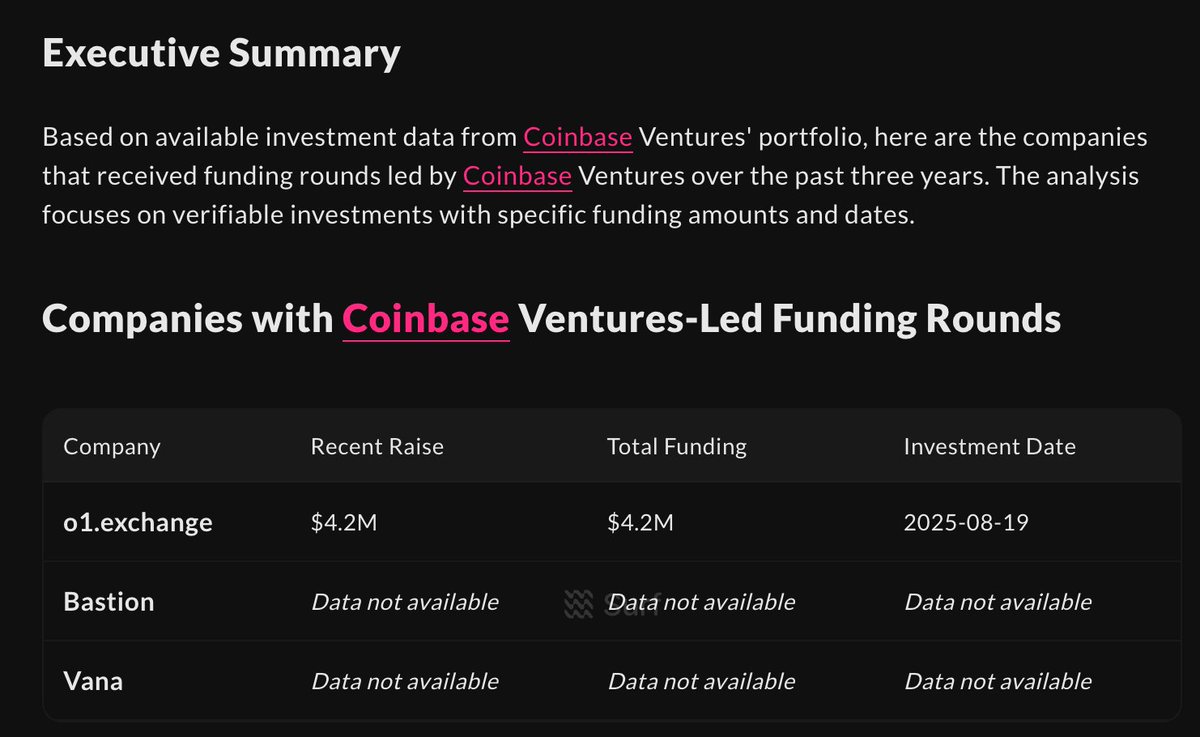

@o1_exchange has accepted the challenge of becoming “Onchain Everything Exchange” where we position ourselves as the onchain version of Coinbase.
Long story short, I just aped in $COIN on Base.